
The block is the clock
Every event is caused by a block and every timestamp is a block timestamp. Scripts never see wall-clock time.
JavaScript that runs on the block clock, trades through the AMM pool and backtests exactly the way it trades.
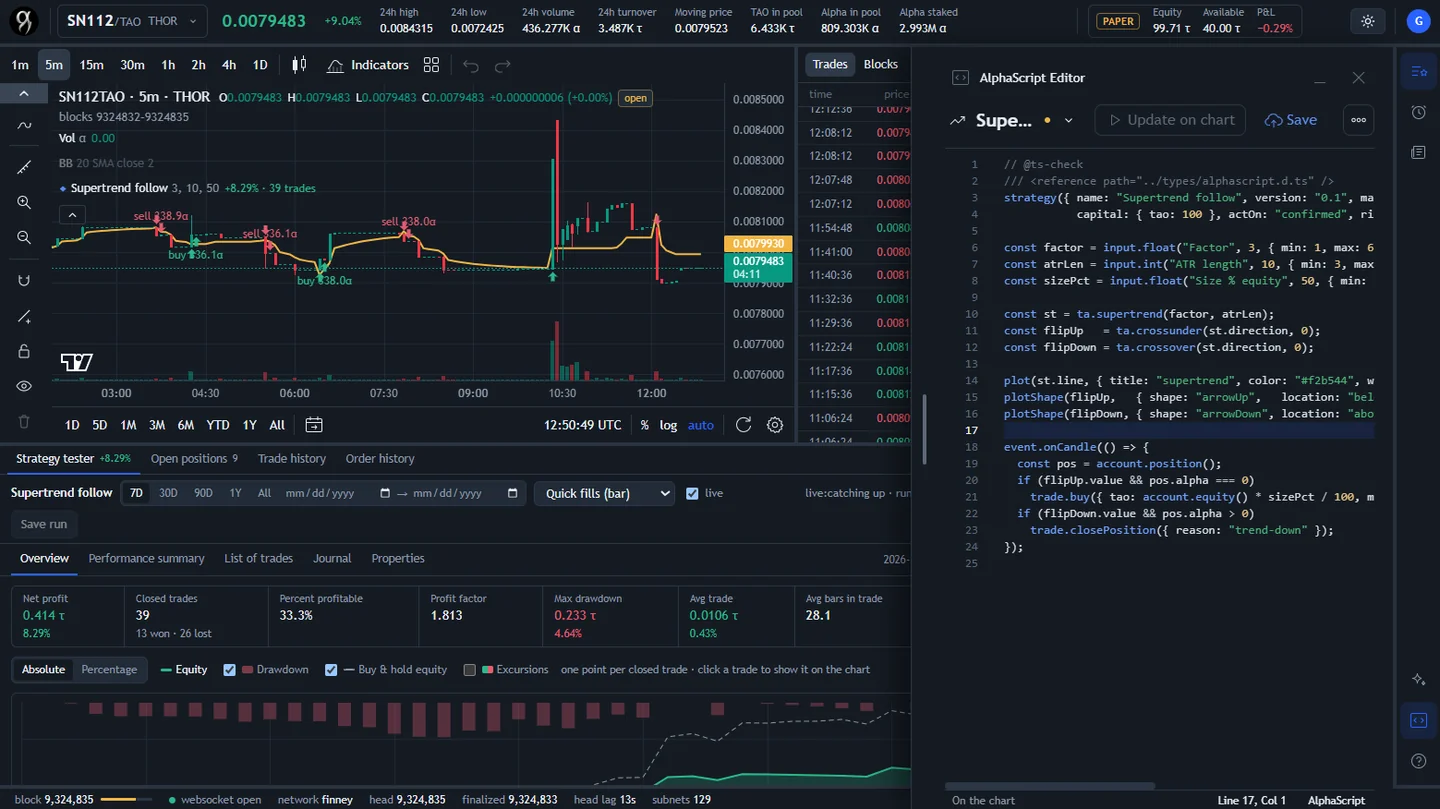
strategy({ name: "EMA cross", version: "0.1", market: "ALPHA:61", resolution: "15m",
           capital: { tao: 100 }, risk: { maxPriceImpactPct: 0.5, maxPositionTao: 50 } });

const fast = ta.ema(candle.close, input.int("Fast EMA", 9, { min: 2 }));
const slow = ta.ema(candle.close, input.int("Slow EMA", 21, { min: 2 }));
const goLong = ta.crossover(fast, slow);
const goFlat = ta.crossunder(fast, slow);

plot(fast, { title: "EMA fast", color: "#2bb889" });
plot(slow, { title: "EMA slow", color: "#f2b544" });

event.onCandle(() => {
  const size = account.equity() * 0.25;
  if (goLong.value && pool.impact(size) < 0.0025)
    trade.buy({ tao: size, maxPrice: pool.price() * 1.01, ttlBlocks: 3 });
  if (goFlat.value && account.position().alpha > 0) trade.closePosition();
});
Series such as fast and goLong are declared once at the top level and advance on every bar. Handlers read their current value with .value and decide what to trade. Getting started walks through it.